
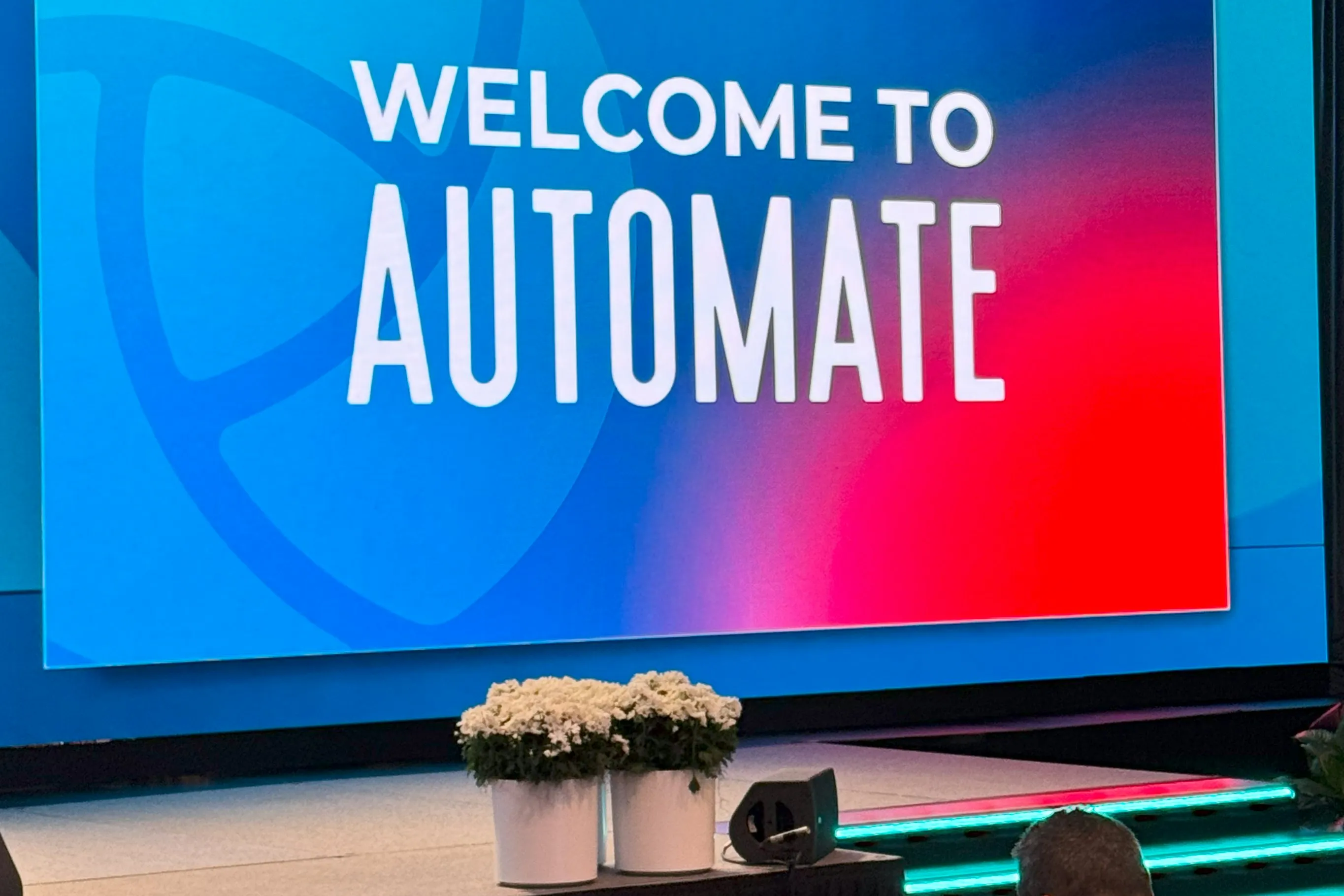
Automate 2025: A Field Report from Detroit
When your job is to scout the next big leap in industrial automation and robotics, there’s one place you need to be each spring: Automate.
So earlier this month our team swapped Santiago’s fall drizzle for Detroit’s industrial buzz and joined nearly 40,000 automation enthusiasts and 800-plus exhibitors under the roof of Huntington Place. It was equal parts tech show, reunion, and crystal ball — and it gave our team at Güil Mobility Ventures the clarity we needed on where to double-down (and where to hold back) in 2025.
Why Automate matters
Automate isn’t just another trade show — it’s North America’s largest convergence of manufacturing automation, industrial robotics, and AI-powered production technology. For an investor-operator like güil, the show is a live dashboard: we see what’s shipping, what’s vaporware, and who’s quietly eating everyone’s lunch. This year, our goal was simple:
- Scout practical automation for warehouses and factories.
- Track the humanoid hype cycle (spoiler: still early for real deployments).
- Build relationships with solution vendors eyeing Latin America but not yet present there.
Show-floor highlights
Modular and plug-and-play everything
From Universal Robots’ snap-together cobot cells to German newcomers pitching robot-as-LEGO, the winning message was: “Configure in hours, not quarters.” For high-mix, low-volume plants, that flexibility is gold.
AI inside — finally useful
If 2024 was the year everyone said “we’re adding AI,” 2025 is the year they actually shipped it. Autonomous Mobile Robots (AMRs) from MiR and OTTO now dynamically re-route around humans in real time, thanks to on-board vision models. Vision stacks for quality inspection were everywhere too — no data-science PhD required.
Digital twins grow up
Siemens and NVIDIA demoed drag-and-drop simulations that mirror your factory’s traffic and energy loads. The ROI pitch: model a layout change today, avoid a million-dollar headache tomorrow. We’re bullish — especially for brownfield warehouses in LATAM that can’t afford trial-and-error upgrades.
Sustainability as a market value
Low-power actuators, energy-recuperating drives, and dashboards that translate kilowatt savings into carbon metrics were crowd-pleasers. When energy costs keep climbing, green isn’t just PR — it’s P&L.
What Automate is not (yet)
Humanoids drew swarms of phones — Agility’s Digit kicked boxes like a champ — but honest conversations with integrators confirmed our hunch: the business cases are still cooking. Same goes for anything consumer-facing. Automate is a playground for industrial and logistics use cases; if you’re building a home robot butler, CES or IFA is your show.
Three key takeaways for operators and investors
1. Hardware is crowded; software is leverage. More than a dozen AMR vendors look eerily similar. Fleet orchestration layers, safety guardrails, and no-code robot-OS platforms, on the other hand, felt differentiated and sticky.
2. Latin America is greenfield. Multiple vendors admitted they have zero channel coverage south of Texas.
3. Speed wins in 2025. Everyone — from tier-one automotive to mom-and-pop machine shops — talked about time-to-value. Integrators that can deliver a robot cell in weeks, not months, will own the budget conversation.
A quick note on Detroit
Beyond the convention center we toured New Lab at Michigan Central, Ford’s renovated Book Depository turned hardware playground. Picture 3-D printers, drone cages, and enough machine tools to make any investor take notice. For us, it underscored how Midwest manufacturing muscle plus fresh capital equals real momentum — worth another visit soon.
Who should book for 2026?
- Plant managers chasing cycle-time gains without ripping out entire lines.
- Supply-chain and warehouse directors tired of forklift traffic jams.
- Systems integrators searching for reliable sub-systems and partners.
- Investors hunting B2B robotics software with clear paths to revenue.
If you’re building a consumer pet robot — or hoping to meet the next Atlas-level humanoid — save your airfare.
Final thoughts
Automate 2025 validated our thesis: industrial automation is moving from “why” to “how fast.” For Güil Mobility Ventures, that means sharpening our focus on software-defined robotics, warehouse mobility, and the tooling that makes integration painless.
— güil Research Lab